
NEW: LADS 2D/3D 720° Displays Bring Full-360° AR/VR, Live eSports and Concerts to Large Audiences
¹ A 6-story high, 50 foot dia. LADS system is licensed for regular use at the Staples Center -- Seen on national broadcasts and by 2 million attendees
Use LADS-IP to Put Your Displays -- In 'A League' of Their Own...
More Than a New Display / Form Factors Patent -- LADS-IP is Literally a 'Game-Changer' -- Here's why: take a leading/single video-game, bring it to a large-audience venue presented on flat 2D display screens for a World Championship; back the game-co./effort with major investment from a single leading China-Tech co. and...? -- a new sports-league: 'Major League Gaming' (MLG) is born, and thrives. That's great for 2D-games only needing flat screens, but how do you take that and move it in a BIG way to a whole new level / league? (And maybe even end up owning a good portion of it too?). That poses a few other questions: Could advanced form factor screen-displays, exclusively capable of live-streaming, seamlessly mapping and displaying any 3D and 2D eSports, VR and AR in Full Panorama literally be in (establish a basis for) a 'League of Their Own'? LADS thinks so. Consider: should we still be using century-old display form factor flat-screens, literally 'out-of-their-league' for displaying the best immersive, player-encompassing 3D content now being built into the latest eSports, VR and AR gaming-tech? The fact is, flat screens would in effect relegate such 360° content 'benched'--out of the game / sitting on the sidelines. Not exactly what the leading 360° eSports, VR and AR game-co.s will want. Surely when VR/AR gaming debuts in large-audience venues they'll want their state-of-the-art games seen and experienced in a BIG way. How do you stream, effectively-represent and display 360° full-panorama and surrounding-immersive game-content on flat screens? And, why be satisfied with no direct interaction being provided between players (and/or attendees) on flat passive-displays used at eSports Championship Games? These questions underscore that there is a vacuum in mid-size and large-size audience display systems, and how a 'Better-than-Flat' solution is needed for state-of-the-art game content exhibition -- that is soon coming, is anything but flat, and will considerably raise the bar.
Instead, consider this: What if, with a comparable backing by one or more other game co.s (nedding their 360° content stunningly / fully exhibited), and a similar level of investing made by one or more major tech-co.s -- a New Immersive-3D eSports, VA and AR Gaming League could be built and thrive? Wherein, the panoramic screens provide a patented displaying of 360° eSports, VR/AR video-game content; are equipped to stream, map and display seamless Live-3D (and 2D) 360° content and player game-action/interactions. The proprietary screen-displays can be dynamically positioned (and/or tilted) in any manner up/down/before their viewing audiences; offer a patented 'dual-perspective' circularity-of-action wherein sprites/objects controllable on the screen by competing players at the venue, dynamically moved anywhere on or around the screen-displays do so such that sychronous sound precisely tracks their motion/panning action; where audience attendees are also empowered/invited to interact with a game and/or live screen content via their handhelds, and even have content/new 'digital merchandise' exhibited on any 360° screen live-streamed directly to their personal wearables/handhelds; where screen interactivity also includes multi-venue attendee and/or player interactions, and more. Where the screen-displays generate a brand recognition--being 'Seen in all the Right Places'.
Imagining a Game-Changer: a large-scale oval/arena-shaped LADS screen-display, with synchronous surround-sound, descends to floor level before a large-audience. Portraying a gladiator-style arena that surrounds two teams of eSports or VR-game players the champions dynamically interact with the immersive game-content around them. The stadium or arena large-audience, seated along various row-heights and surrounding the screen, take in the largest 360° eSports, VR and AR gaming-panorama experienced anywhere. The arena-scene action is also broadcast to viewers at home, and can exclusively be broadcast concurrently to other large-venues. The arena-shaped screen's 720° form factor exhibits stunning live-streamed 3D and/or 2D interactive imagery seamlessly about its exterior and interior perimeter-surfaces. Positionable and chameleon-like, the arena-shaped screen-display becomes the dynamic interactive battleground-medium on which each new 360° eSports, VR or AR game, match or round is brought to its respective players and large audiences. LADS-IP even includes the 720° display of 3D (and 2D) camera-ring captures -- such that full-panoramas recorded and/or streamed live from drones or small lighter-than-air airships capture any and all arena or stadium wide action and that of their audiences.
More about the market: You're probably aware, gaming championship viewership has exploded, taking in more viewers than traditional/major sports. eSports/gaming now takes in more revenues than the entire international film industry (e.g., one game alone earns more than all Harry Potter movies combined). Colleges are granting full scholarships to major ePlayers expected to draw large crowds (revenues) at their own venues. Even new eSports-dedicated large-venues are now being built which will surely need more than a century-old flat screen approach to effectively engage and interact with large audiences, and to be truly VR-game / AR-game ready. The foregoing features, and various others (see our extensive 'Technically Speaking' list below) are among the differentiators LADS envisions as literal 'Game-Changers' -- providing a sound basis on which a new, 21st-Century Major Gaming League can be founded, taken to whole new levels and thrive. In other words, if you're company is looking for a Next BIG Thing in large-format display-tech, sure to be seen 'In a League of its Own', and which also happens to have a comprehensive patent position -- this is it.
LADS NEW Seamless 720° Live-3D / Live-2D Display Systems (best viewed with 3D red/cyan glasses):
IMAGINE: Anything in VR/AR--Seen, Played, Experienced or Interacted With--Now Made Viewable to Audiences of ANY Size
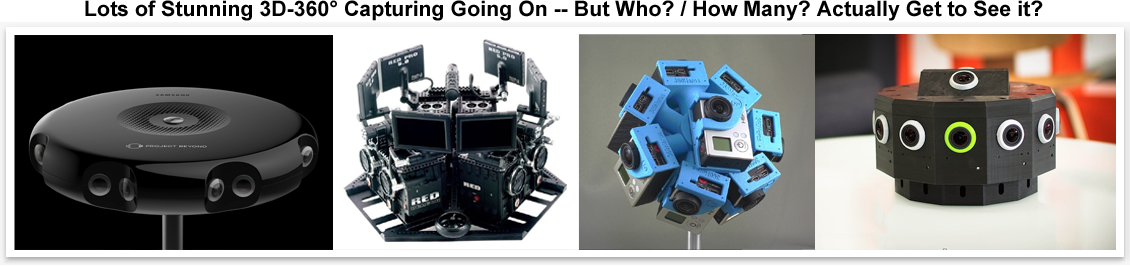
Shattering the Limits of the Single-Person VR/AR Viewing Experience -- VR and AR Head Mounted Display (HMD) content is by design meant to be stunning in its immersive and panoramic viewing experience--to the single-person wearing the HMD. But therein lies the marketing problem: How do you effectively increase awareness of VR/AR content when it's designed to be seen and experienced by just one person at a time? Or better yet, how can you get your content regularly seen and experienced by mid-size, large or even massive audiences? Constraining the 360° content to a conventional rectangular screen (box-shape) either grossly-distorts it, or portrays only a minority-fraction of it--like viewing it through a keyhole. Similar problems are encountered with stunning 360° HD and 4K panorama now being captured by cutting-edge drone and camera-ring devices. But absent an effective displaying means for the full 360° 3D or 2D captures, only a small-fraction of the full panorama-size is what's being shown / represented (again, constrained within a 'rectangular box'). That's like going to an IMAX movie and being allowed to see no more than a tenth of the film's full immersive imagery at a time. It just doesn't make sense. If you've got stunning VR/AR content or beautifully-captured panorama to show -- it's time to think out of 'the box'.
Whether you're viewing an interior, exterior or both surfaces of a LADS screen-system, a full 360° immersive scene is always presented to a viewing audience. Note in the images at the top of page, when the panorama is imaged in 360° on both the exterior and interior surfaces how the outer and inner 3D panoramas complement each other. By combining two 3D depths of field--a doubled-depth 3D panoramic magic occurs (best seen with 3D glasses). For example, when a nearest screen-portion 3D depth is viewed aligned above that of a furthest screen-portion 3D depth--an unprecedented dimensionality of the 720-3D screen-system is presented e.g., experienced by a large-venue viewing audience. Each of the 360° interior and exterior panorama can comprise entirely different image content and/or image-segments, or two concurrent-and-complementing 360° panoramas (in 3D or in 2D). In the latter case the 360° panoramas--whether live or pre-recorded--extend seamlessly and entirely around an interior surface and an exterior surface of a LADS screen. Such imagery, whether imaged on LADS cylindrical or dome form factor screens, can be projected from each of a series of projectors, or imaged within distinct pixel array screen-segments. For a comprehensive listing of patent features see Technically Speaking below.
Currently, VR / AR head mounted displays 'HMDs' are limited to an immersive first-person-video ‘FPV’ 360° viewing-experience. Soon however, VR and AR content will also be configured for viewing by, and for game interaction between, multiple players over a Head Mounted Display 'HMD' . Leading companies making HMDs have made it a top-priority that their HMD becomes a major platform for potentially scores of new VR / AR games, including team-competition eSports games. Many of these new VR / AR games will make their way into large-audience venues where eSports Championships are now attracting some of the largest viewing audiences ever. Anticipating the advent of VR / AR gaming, and a need for an immersive portrayal of such, LADS' screen-display systems are poised to stunningly display encompassing VR or AR content in LADS' proprietary 720° (and 360°) full-panoramic formats.
LADS Form Factors Approach Proven to Substantially Increase Audience-Revenues -- In the large-audience venue market LADS 'center stage' display systems take aim at expanding audiences, attendance and revenues e.g., by up to 25%. How? LADS 360° cylindrical and oval screen-display form factors are complementary to the interior shape of almost all large-audience venues. Each form factor--whether employing LADS' projection and/or pixelated-array imaging solutions--substantially reduces the distance of a venue's furthest seats from a LADS screen (e.g., by 60%), which in turn, increases the closer prime-seating row-depth that completely surrounds the circumference of the centralized screen--making it ideal for entertainers to best communicate with and engage larger and much closer audiences. A realization of the audience-increasing power of this form factor led U2, on their 360° Tour, to the all-time highest-grossing concert tour yielding $772 million revenue (note: even a 20% avg. increase of which is $150M).
Eco-Friendlier Too: Even lighting and sound energy requirements can be significantly reduced due to LADS screen-displays providing a significantly closer proximity to their surrounding audiences. For example, according to dictates of physics, when a given area requiring sound and lighting is increased e.g., by 2x or 4x, an exponential increase in energy output ('by the square') will then be needed: 4x or 16x sound/audio levels respectively. Thus, a LADS generally-central screen-display, lighting and sound system, being 60% closer from the furthest seats of a venue, could readily use one-fourth of the sound and lighting energy needed to produce an equivalent audio and lighting attendee-experience e.g., when a flat-screen and its furthest audience seating are typically located at opposite ends of a large-audience venue.
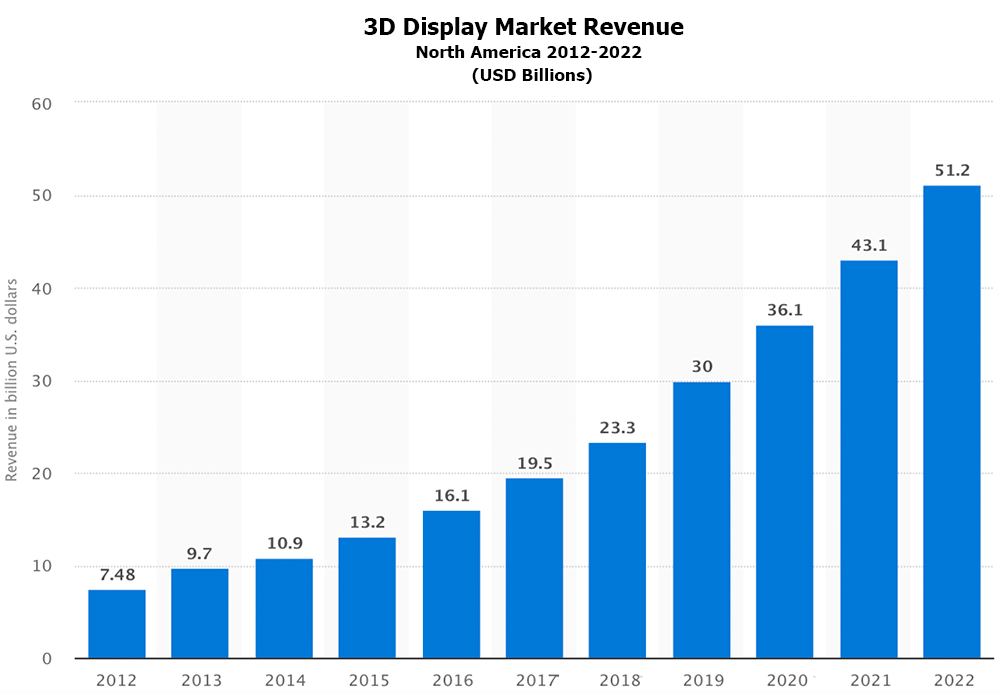
3D Display Revenues Forecasted in U.S.
Revenues for 3D display systems will more than double in the next four years from $23 to $51 billion (see graph above). Smartphone and tablet makers have released products with 3D viewing capablility and more are coming soon. All of which makes 'now' the opportune time to start integrating high-profile recorded, Live-3D and 2D video content into eSports Championships, concert and events at large-audience venues, and at prime digital-signage locations. Further patented/added-value features of the LADS systems include: 2D and 3D game systems 'in-the-round' enhanced by a circularity of action; single and multi-axes screen positionings before a live audience; handheld device social-interactivity at live shows, even HD 'audience-selfies' at a single venue, or shared concurrently between two or more venues; and, downloads of screen content/video/favorite entertainers (recorded or live-streamed) onto attendees' handheld devices and onto LADS' Video Imaging Apparel and other wearables. Think: recorded and live-action concert VIA T-shirts (versus printed shirts). For a comprehensive listing of LADS high-profile display system and their patented features see 'Technically Speaking' immediately below. Such features, (among those below) already prompted several calls from the world's largest patent-licensing/venture capital company (seeking to buy the LADS '346 patent).
TECHNICALLY SPEAKING
The descriptions below provide some detail of key features of LADS' Screen-Display Systems, excerpted from the LADS™ '346 patent.
LADS Screen-Display Systems -- Specifications:
Visual Image Content Types exteriorly and / or interiorly displayable on Cylindrical (and dome) form factor screens:
• 360°-Gaming and Live Player and/or Attendee Interactivity
• Any 2D and 3D VR and AR immersive/surrounding content
• Live 3D-720 and 3D-360 (or 2D) visual media content, including eSports / Championship Games, Concert Tours and Sports
• 3D-720 and 3D-360 (or 2D) Drone and / or Camera-Ring captured panoramas pre-recorded and live-streamed
• 2D or 3D video game content and game content featuring LADS patented circularity of action with synchronous object-tracking audio
• 3D-720 and 3D-360 (or 2D) Digital Signage
• 3D-720 and 3D-360 (or 2D) mall-keystone / upscale Retail venues
• Live, or ‘real-time’ video projected visual media content optionally including synchronous audio
• Live, or ‘real-time’ electronically-imaged pixelated-display content optionally including synchronous audio
• Live reception of video captured segments, including synchronous reception and display of multi-channel, or multiplexed,
broadcasts or simulcasts (from one or more cameras, or camera arrays)
• Panoramic, wide-angle or intergrally-continual content exhibited with a circularity of movement
• Image content acquired by one or more video cameras locally and / or remotely
• Live event multi-venue simulcasts
• Streaming video and audio
• Sporting events featuring a circularity of action, e.g., Olympic track and field, skating, bicycling,
oval-track racing
• 2D and 3D video formats
• 2D and 3D film formats
• Broadcast transmission of video
• Satellite transmission of content
• Panoramic image content
• Recordable video content (analog or digital video)
• Pre-recorded video content (analog or digital video)
• HDTV, NTSC, PAL, DVD, DV, miniDV, S-Video, MPEG, video and audio
• Seamless algorithmic and / or optical shaping and edge-matching of panoramic segments
• Content displayable responsive to control signals initiated locally or remotely
• Projected film content
• Synchronized video on adjacent screen segments and/or over entire panoramas
• SMPTE and / or MIDI or other timecode-based synchronizations (video and / or film)
• MIDI code, or MIDI instrument or controller, event triggering of audio and / or video content, objects and effects
• Performer-movement event triggering of audio and / or video content, objects and effects (motion-triggering locally or remotely)
• Multi-venue display of partial or full-audience and audience interaction
LADS PROJECTION Screen-Display Systems -- configured exteriorly or interiorly viewable 360°, or both sides concurently viewable 720°:
• Rigid, semi-rigid or flexible screen-display material
• Screen-display material suitable for rear-projection
• Screen-display material hung in a drapery or curtain-like manner from a screen-display upper support means
• Screen-display material suitable for opaque-screen projection -- on either side 360°, or both screen-display sides 720°
• Translucent screen-display material
• Semi-transparent screen-display material
• Opaque screen-display material
• Screen-displays configured to receive imagery projected on an interior surface from a ring of outward-facing projectors
• Screen-displays configured to receive imagery projected on an exterior surface from a ring of inward-facing projectors
• 360° or arced transparent material (e.g., safety-glass or polycarbonate) having sufficient rigidity to form a self-
supporting auxiliary screen-display support means which supports a similarly shaped screen-display material
LADS PIXEL-ARRAY Screen-Display Systems -- configured exteriorly or interiorly viewable 360°, or both sides concurently viewable 720°:
• Pixelated element displays, including screen-displays comprising one or more arrays of the same
• LCD or pixelated screen-display material
• Electronically-imaged screen-displays
• Flexible pixel element screen-displays, or other video-capable flexible pixelated material
• Plasma screen-display material
• CRTs configured adjacently proximate one another
• Screen-display incorporated into and / or supported by an architectural structure
LADS Pressurized Screen-Display Systems -- configured exteriorly or interiorly viewable 360°, or both sides concurently viewable 720°:
• Screen-display material (e.g., dome-shaped) of a type suitable for retaining one or more gases
• Screen-display material mounted on or integrated into lighter-than-air aircraft (e.g., airships or balloons)
LADS Screen-Display Geometries Supported:
• Cylindrical, oval, ovoidal, elliptical, domed, hemispherical, spherical and portions of spheres, cylinders and
portions of cylinders, cones and portions of cones; one or more standalone or display-adjacent
arcs, and the like.
LADS Screen-Display Support Means (for supporting the shape of the screen-display) comprising:
• One or more screen or screen perimeter support members (e.g., sized and shaped according to an upper
and/or lower portion of a screen-display) and optionally comprising screen segments sized and shaped for
quick assembly and disassembly
• One or more hemispherical or dome arc supports formed of a rigid or semi-rigid material (optionally a
transparent material)
flat panel screens or plasma screens, configured to exhibit substantially contiguous, panoramic and
circumnavigably viewable imagery
• Employing an architectural-structure as a support means for one or more screen-display(s)
• One or more screen portions made of a rigid or semi-rigid material (e.g. suitable for rear-screen, or
opaque-screen, projections) and coupling of the screen portion(s) to one or more support members
• Suspending material suitable for rear-projection, or flexible pixelated material, in a drapery-like
or curtain-like manner from, or coupled to, a display upper support means or perimeter thereof
• Locating display-screen material coaxially within a transparent, rigid or semi-rigid self-supporting
auxiliary display support means
• Employing pressurized air within an inflatable screen-display
• Employing one or more compressed, or lighter-than-air, gases within an inflatable screen-display
Single-Axis and Multi-Axes Screen-Display Positioning Means -- comprising one or more of the following:
• Computer-controllable motors e.g., to raise/lower, tilt or move sideways a cable-tethered screen display
• Computer-automated stepper motors in combination with cables, belts and pulley(s), rack-and-pinion
arrangements, connecting arms, cams, hydraulic arms, and the like
• Gantry (e.g., lateral positioning, or 3-axis positioning i.e., in combination with vertical axis
• Motion-control actuators
• Hydraulic actuators
• Motors and/or winches
• Architectural-structure supported screen-display(s)
• One or more compressed, or lighter-than-air, gases e.g., within an inflatable screen-display
• Lighter-than-air aircraft or balloon positioned screen-display(s)
Positioning Means for Positioning One or More Screen-Displays (e.g., to one or more heights), during or providing:
• Viewing, before a large audience, of a screen-display exterior surface-perimeter
• Viewing, before a large audience, of a screen-display interior surface-perimeter
• Viewing, before a large audience, of a screen-display exterior surface-perimeter and/or interior
surface-perimeter
• Viewing, before a large audience, of a partial cylindrical or arced display, with optional positioning means
for locating the arced-display such that it is, exteriorly, and/or interiorly, viewable, or circumnavigably
viewable
• A multitude of vantage points exterior to and surrounding one or more screen-displays
• A multitude of dual-perspective vantage points from which to view visual-media content featuring
a circularity of action on at least one imaging surface-perimeter, optionally including a panning of
audible sound synchronized with the movement of objects viewable on a screen-display
• Circumnavigable viewing of a screen-display
Exhibiting Means for the Displaying of Visual Media Content (comprising one or more of the following):
• One or more inward-facing projectors external to, or surrounding, a screen-display
• One or more outward-facing projectors internal to, or located within, a screen-display
perimeter
• A projector with a fish-eye lens internal to, or within, a screen-display
perimeter
• An array, or one or more pixel element displays, or electronically-imaged displays, e.g., LCDs,
CRTs, flat panel screens, plasma screens, or screens comprised of flexible pixelated material
• Redundant projectors aligned to project the same image-content onto the same side and/or on
opposite sides of one or more screen-segments, e.g., to increase the brightness of the projected
imagery, and/or to provide a backup second projector in the event of a failure of a first projector
• Exhibiting means scalable from room-sized systems, to arena, stadium and large outdoor settings
• One or more video projectors receiving video signal from one or more video-processing components
• One or more film projectors
• Video 2D and 3D content live-capture or pre-recorded transmission and / or playback components
• Satellite video-reception apparatus
Video Transmission/Communication (comprising one or more of the following:)
• Wireless
• Wire / cable (analog and / or digital), Firewire, IEEE-1394, fiber optic
• Streaming
• Satellite
• Broadcast
• Live Simulcast, to one or more display systems at location(s) other than actual event, and / or for
multi-venue interactivity
• Video from local and/or remote locations
Inquiries: Please see 'Contact Information' below
 Facebook
 Linkedin
 Twitter